Evanspark ELCC Academy Logo

Our proprietary curriculum is sophisticated and world-class.

Through the Evanspark ELCC Academy proprietary curriculum, we offer an incredible opportunity for children to explore, learn, and contribute to the world. Our students develop vital social skills by interacting with peers, and they are engaged in a unique balance of purposeful play and structured learning-ensuring they aren't just playing, and aren't just learning.

We believe academics matter. At Evanspark ELCC Academy, core fundamental skills are at the heart of our curriculum, which is constantly advancing based on the latest research in neuroscience and early childhood education.
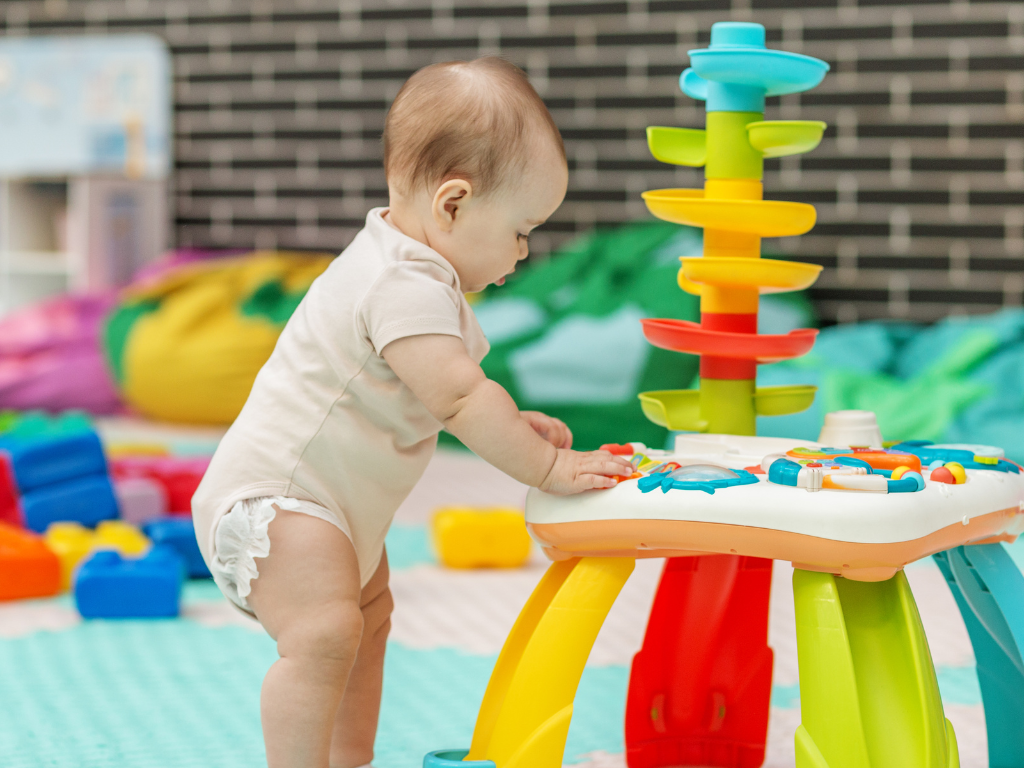
Click on the back of a Curriculum card below to learn more about the courses offered within each pillar.

Preparing Your Child for the
Challenges of Tomorrow

S.T.E.M.

Science
Technology
Engineering
Math
Coding
Giving Your Child
A Foundation for Success

Literacy

Reading
Writing
Math Language
Second Language
Developing Your Child's Creativity and Skill of Creative Thinking

Fine Arts

Dance
Music
Creative Play
Drama
Visual Arts

Preparing Your Child for the Challenges of Tomorrow

Sensitive period of brain development: Numbers

Critical thinking and problem-solving are among the most essential skills students can learn today. As adults, these abilities are cardinal tools that help us navigate relationships, employment, media, and the world at large.

When children engage in STEM activities (Science, Technology, Engineering, and Math) in their early years, critical thinking is nurtured at a time when the brain's foundations are most flexible. A solid foundation established between the ages of 1-5 allows for more creative problem-solving and sophisticated reasoning in the future.

Science
The Evanspark ELCC Academy Science Program introduces students to the scientific method where they are presented with questions, probabilities, hypothesis testing, and how to draw conclusions. This program introduces the children to various subjects depending on interest and the season. Our science curriculum is strongly guided by students and follows a project-based approach, nurturing creative thinking, leadership skills, and reasoning abilities.
Hands-On Discovery

Children investigate real materials, test ideas, and observe outcomes to build curiosity, confidence, and independent thinking.

Think, Explain, Reflect

Students practice sharing their predictions and findings, strengthening communication, reasoning, and collaborative problem-solving.

Technology
Evanspark ELCC Academy Schools are very careful not to use technology to replace tangible experiences in the classrooms. Instead of teaching math or writing through apps, we provide games children can use with all of their senses, and manipulate at will. Technology can also serve as a valuable tool for documentation children can make short videos or take photos of their learning experiences to help to re-live and re-explore, thus continuing the learning process.
Digital Fluency

Students interact with technology purposefully, learning to use basic tools as creators rather than just consumers.

Interactive Learning

Sensory games and guided tech experiences bridge tangible activities with digital understanding.

Engineering
The Evanspark ELCC Academy Engineering Program plays a fundamental role in setting the foundations for future learning. Children engineer by solving problems. Our program offers engaging and stimulating problem solving experiences for children. We incorporate activities with materials and situations that require solving, and are interesting and meaningful for students. Engineering activities provide opportunities for children to grow and mature, and engineering through design challenges promote social and emotional learning. As children engineer, they build empathy by working alongside their peers to solve a problem.
Design Thinking

Children engage in practical design challenges that stimulate spatial awareness and structural understanding.

Collaborative Problem Solving

Working alongside peers to test builds and solve problems fosters empathy and teamwork.

Math
Introducing mathematics in early childhood education is proven to promote language and literacy skills. We place a great emphasis on helping students gain reasoning skills, and apply mathematical concepts introduced in a practical way. Evanspark ELCC Academy's Math Program teaches children to quantify numbers and understand the fundamentals of addition, division, and multiplication in upper level classes. These strong concepts taught in the Junior Kindergarten programs leave students well-equipped for entrance into elementary school.
Quantitative Reasoning

Practical, daily applications of math help children understand numbers, shapes, and early arithmetic.

Logical Foundation

Building a strong comprehension of mathematical logic primes students for advanced problem-solving.

Coding
Coding helps equip children with the ability to stick with a problem and work on finding a solution. It also helps them learn to quickly fix and try again in different ways when something doesn't work out. It encourages problem-solving, persistence, creativity, and digital literacy. It also helps boost confidence. Coding has been proven to help children learn, understand, and communicate basic logic.
Algorithmic Logic

Early coding exercises teach children sequence, patterns, and cause-and-effect reasoning.

Resilience & Persistence

Debugging challenges builds confidence and the ability to persist through difficult problems.

Giving Your Child A Foundation for Success

Sensitive period of brain development: Language

Children crave knowledge, and literacy is the gateway to advanced learning. Every academic discipline, including mathematics, has a strong foundation in literacy. Research confirms that a robust grasp of language at an early age is essential for healthy brain development and lifelong academic success.

Children who are routinely immersed in reading and writing activities thrive. Quality early learning in a dedicated childcare or preschool environment can have a significant and lasting positive impact on a child's communicative abilities.

In 2008, the National Institute for Literacy issued a landmark report, "Developing Early Literacy: Report of the National Early Literacy Panel." Among its many findings, the report stated that foundational reading and writing skills developed from birth to age five have a clear and consistently strong relationship with later conventional literacy skills.

Source: Early Literacy | Family and Community Engagement Research Compendium

Reading
Literacy is strongly encouraged at Evanspark ELCC Academy, as it is one of the most important skills a child requires to be successful at school, and in life. Research shows that learning to read at a young age is excellent for brain development and lifelong academic success. The Evanspark ELCC Academy Early Education Reading program was designed to teach children to read, not only phonetically, but also by developing the seven essential components of reading.

Our program provides students with the tools to build upon their vocabulary and literacy skills. Teachers follow the progress of each child, and each year, parents are invited to learn the Evanspark ELCC Academy letter-by-letter method: A simple, playful and effective way to teach your child to read at home.
Phonemic Awareness

Structured letter-by-letter methods build the essential building blocks for reading fluency.

Lifelong Comprehension

Early literacy activities nurture a profound love for literature and active story comprehension.

Writing
Our exclusive writing program at Evanspark ELCC Academy was created to promote child development in the early years.

It introduces students to essential pre-writing and fine motor exercises that train hand muscles to write, develops hand-eye coordination, and familiarizes children with lines, curves, letters and words. Writing is introduced every day with a combination of fine motor, games and activities, sensory experiences, drawing, and one-to-one writing.
Fine Motor Mastery

Purposeful exercises strengthen hand muscles and enhance hand-eye coordination for early handwriting.

Expressive Communication

Moving from lines and curves to letters and words helps children articulate their inner worlds.

Math Language
Math helps children problem solve, measure and develop their own spatial awareness, and teaches them how to use and understand shapes.

Children are often introduced to abstract mathematical language prematurely. As a result, many children struggle to grasp their meaning. Early math is as important as early reading. Children must learn the concepts behind math symbols, and we need to be very deliberate in the language we use to teach math concepts in the early years. In essence, children must understand how to read and speak math before they can engage in math.

Children have super curious brains. They want to learn more, and our Math Language program provides children with an essential foundation and bridge for continued learning.
Conceptual Vocabulary

Teaching the language behind numbers ensures children comprehend meaning before memorizing abstract symbols.

Spatial Awareness

Understanding geometric terms and spatial logic forms a vital bridge for continuous mathematical learning.

Second Language
The Evanspark ELCC Academy Second Language Program is carefully designed to be mindful and meaningful, created to instill the habit of curiosity and lifelong learning. The early learning of languages is known to stimulate children's cognitive capability and improve their ability to process information, including memory, speech, and sensory perception for life. Research shows that children who learn more than one language have advanced reading skills, are more socially aware, and have better vocabulary in their native language.
Cognitive Flexibility

Exposure to new languages stimulates neural pathways, drastically improving memory and speech processing.

Cultural Appreciation

Early language immersion builds social awareness and broadens a child's understanding of diverse communities.

Developing Your Child's Creativity and Best of Creative Thinking

Sensitive period of brain development: Emotional Control, Intelligence & Peer Social Skills

Children develop self-regulation through their relationships. Emotional control and self-regulation start at birth, with key brain development in this area peaking between the ages of 0-3. During this window, children are constantly observing and learning from adults, peers, and the community around them.

A child's emotional state and their ability to regulate feelings are key factors in the health of their relationships, home life, mental health, and academic performance. Studies have shown that chronic stress and anxiety can negatively affect brain development, potentially hindering a child's natural ability to learn and thrive.

Because early language skills are still developing, communication can often be a source of frustration. Creative activities-such as dance, music, drama, and visual arts-serve as vital, therapeutic platforms for expression. Through these arts, children learn to communicate their joys, hopes, and frustrations beyond just words. They also gain the ability to interpret the emotions of their peers, building a strong foundation of emotional intelligence.

Dance
Dance is the physical expression through movement and rhythm of relationships, feelings, and ideas. Dance fosters opportunities for discussion and practice. In a safe and secure environment, students can explore how to express feelings, interpret the emotions of others and practice being empathetic people. Research shows that when children dance together, their abilities to collaborate and cooperate improve.

At Evanspark ELCC Academy, Dance is an important part of our curriculum because we teach the whole child, and this is a great opportunity for children to express themselves from the inside out.
Physical Expression

Movement activities develop coordination, rhythm, and gross motor skills in a supportive group setting.

Creative Freedom

Children explore translating their emotions and ideas into dynamic physical storytelling.

Music
Learning and playing music at a young age significantly influences early childhood development including verbal communication, problem solving, and sensory awareness. Evanspark ELCC Academys Music Program is taught with a wide variety of musical instruments that assist children in learning how to creatively interpret the fundamentals of music such as notes, tempos and musical appreciation.

The Evanspark ELCC Academy music curriculum proudly incorporates the award-winning program Playful Arts Learning Series. Through the integration of childrens literature, storytelling, drama, creative movement, song and instrumental play, classical music is taken from its sophisticated, mysterious realm to one that is completely child-centred.
Auditory Processing

Exploring rhythm and pitch enhances active listening skills and auditory memory.

Harmonic Collaboration

Group music activities teach synchronization, creativity, and the joy of shared artistic creation.

Creative Play
Creative Play celebrates self-discovery. Nurturing self-expression is an essential part of Evanspark ELCC Academys proprietary curriculum. Our schools present every component of our academic curriculum in the form of games, fun projects, and engaging activities. In addition, Evanspark ELCC Academy ensures that children have time to explore the classroom at their own pace while interacting with others and the classroom environment in their own creative way.

By choosing how to play, who to play with, and what to play, children further develop their creativity. At the same time, unstructured play gives children the opportunity to engage with others, and learn how to socialize in the process.
Imaginative Exploration

Open-ended scenarios let children construct their own narratives and explore limitless possibilities.

Social Negotiation

Role-playing with peers builds crucial negotiation, empathy, and interpersonal skills.

Drama
Children are introduced to a variety of real and imaginary situations, allowing them to express emotions and to be empathetic. By acting out pretend roles and scenarios, kids are encouraged to think critically and creatively.

An important part of Evanspark ELCC Academy Creators, Drama helps build confidence, drives creativity, helps children develop empathy, and increases a childs ability to concentrate. By taking on different roles, children are taught different behaviours and even perspectives.
Empathetic Roleplay

Stepping into different characters helps students understand varying perspectives and complex emotions.

Confident Oratory

Performance activities foster self-assurance, vocal projection, and public speaking confidence.

Visual Arts
Visual arts enables our students to explore colours, textures, materials, and other interesting, tactical items. Children are exposed to art history, learning about famous artists and artistic styles. They explore three dimensional art, natural life art, light table work, and many other exciting techniques.

The process of exploring and nurturing creativity helps to provide a new language and another avenue for children to express themselves. Art experiences are presented daily in the classroom, with Evanspark ELCC Academy trained art teachers working with children on a weekly basis.
Creative Expression

Exploring various mediums gives children tools to express thoughts they might not yet have words for.

Process over Product

Emphasizing the artistic journey nurtures creative risk-taking and divergent thinking.

Teaching Your Child to Make a Difference

Sensitive period of brain development: Peer Social Skills

Children are capable and competent-they can truly make a difference. While it is sometimes easy for adults to discount a child's abilities, it is vital to understand that children are constantly developing their own identities based on the environment and the respect shown to them.

When children are treated with respect, they learn that they are deserving of it. By being recognized as capable and competent, they internalize these values and naturally extend that same recognition to their peers. Understanding the connections within our communities also helps them define their own unique roles in the world.

The Change-Makers component of the Evanspark ELCC Academy curriculum focuses on contributing with an astute understanding of community and a deep foundation of respect. Our activities are rooted in empowering exercises that encourage collaboration, social recognition, and a connection to the environment around them.

Citizenship
Citizenship is more than the affiliation we have with our country. For children, their first citizenship is with their family. Then, they are citizens of their communities, including their peer group at school, their neighbourhood, their city, and onwards. At Evanspark ELCC Academy, children learn the dynamics of these layers, and how ultimately, we are all citizens of this earth. Understanding this clarifies a sense of belonging on many levels, and helps them examine how to become better citizens. An example of this is how we incorporate being mindful of things like waste. We use this as a key tool in our curriculum to educate in context. Our students learn not to waste water. They are taught to put it in a class plant or use it to wash the paint brushes. This helps them learn that they can make a difference as citizens of this world and their communities. Children also learn that they can make a bigger difference when they work together

We all work together to give children a sense of belonging and the power to make things different.
Community Awareness

We teach children their role in the classroom community, fostering responsibility and mutual respect.

Ethical Foundations

Early discussions on fairness and help build a strong internal moral compass.

Contribution
At Evanspark ELCC Academy, children learn that they have a voice and it is important. Children also learn to have courage in expressing themselves, and to have respect for others when they do the same. Not only are children taught the importance of contribution, they are also taught the importance of listening to and observing other children's contributions. Children learn how they can contribute to their families, their friend groups, their class, and support their communities to help change the world. Children will learn about how their actions impact others. Enrolment in our Evanspark ELCC Academy Private School means your child will have four years to learn what its like to care about something or someone.

Children who are taught to find their voice, ultimately learn that they can make a difference.
Purposeful Engagement

Involving children in tasks shows them that their efforts genuinely matter to the community.

Fostering Leadership

Taking ownership of small duties builds early leadership qualities and civic pride.

Culture Immersion
The Evanspark ELCC Academy Cultural Immersion program immerses children in a variety of cultural and linguistic co-curriculums which help children understand and appreciate different perspectives from around the world. Children are exposed to greater insights, diverse sources of creativity, and enhanced social and learning skills that they benefit from throughout life. Culture immersion is very important in the early years. Diversity has a direct impact on student performance. Students learn and perform better in diverse environments. Children who experience cultural immersion are more likely to have heightened problem solving, critical thinking, and creativity skills.

Children are also inspired to be empathetic, responsible, and highly collaborative.
Global Perspective

Introducing traditions from around the world builds inclusivity and open-mindedness.

Celebrating Diversity

Exploring varied cuisines, arts, and stories teaches respect for human differences.

Yoga
The Evanspark ELCC Academy Yoga Program teaches students breathing techniques and yoga poses that enhance concentration, increase flexibility and balance, boosts confidence and relaxes the mind.

These crucial skills have been shown to effectively increase self-control, self-confidence, self-respect, positive communication and listening skills. Children learn to appreciate themselves and their peers, and show increased empathy and compassion for others. Children also learn to self sooth, relax on demand, and to have an outlet in times of physical and psychological stress.

Yoga is also excellent exercise for young children.
Mind-Body Connection

Physical postures and breathing exercises promote focus, flexibility, and physical self-awareness.

Emotional Regulation

Children learn mindfulness techniques to calm themselves and navigate big emotions.

Outdoor & Nature Program
These days, children are spending more time than ever indoors, playing on iPhones, or streaming TV. However, there is so much available research on the benefits of outdoor play. Playing outdoors promotes well-being and wholesome physical development. At Evanspark ELCC Academy, children get outdoors twice daily and engage in games and materials designed to further their physical development. Our students learn about the natural elements and their surroundings when they are outside. For example, they learn about the weather and the change in seasons. Outdoor play experiences can help develop gross motor skills and muscles at the same time.

Hands-on learning and natural environments stimulate children's senses through what they hear, touch, see and feel. Outdoor play with other children helps them gain social skills by interacting, collaborating, and negotiating with others.
Environmental Stewardship

Interacting closely with nature builds an intuitive respect for the earth and environments.

Sensory Grounding

Outdoor play provides vital sensory input, reducing stress and stimulating natural curiosity.


Discover More Tools for Early Learning Education

At Evanspark ELCC Academy, your child is given the freedom to learn and grow through play. Our proprietary curriculum is designed to prepare them not just for kindergarten, but for life.

Evanspark ELCC Academy Founder and Early Learning Expert, Natacha Beim, developed this program to encourage children to explore, learn, and discover how they can contribute meaningfully to the world around them.